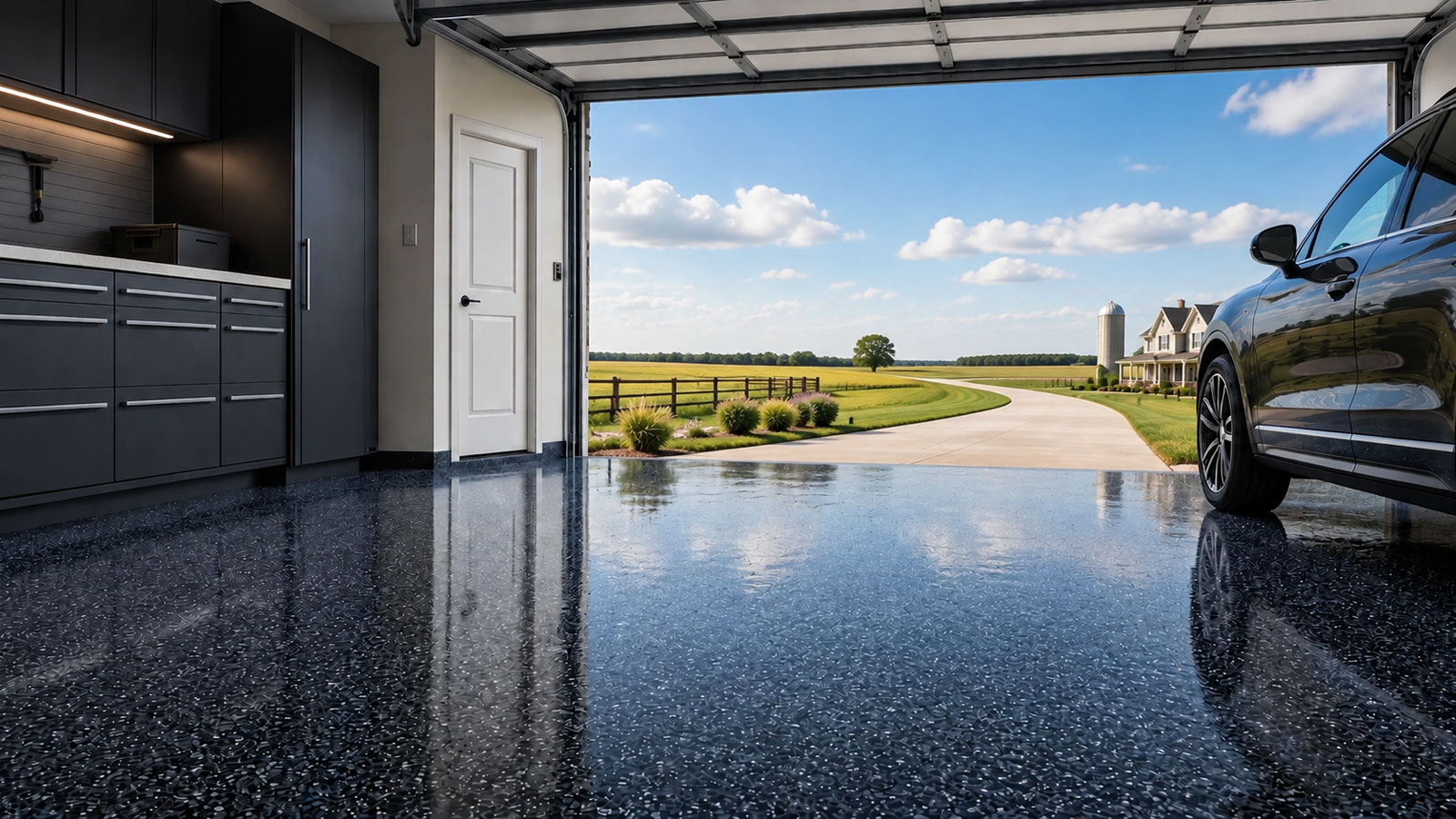
Garage Floor Coating in Altoona, IA
Floor Coating Services in Altoona, IA
Altoona was founded in 1868 but is now a fast-growing east-metro city. Its population increased from 19,565 in 2020 to roughly 22,800 by 2025. Older Altoona properties may therefore contain paint, previous coatings or later garage additions, while fast-growth neighborhoods more often start with young concrete and builder surface treatments. Neither condition is automatically easier to prepare.
Stormwater planning is particularly specific here. Altoona lies in the Mud Creek, Camp Creek, and Spring Creek watersheds, and the city has studied Mud Creek flooding partly to understand how upstream development affects runoff. Mud Creek planning shows that upstream development can matter to runoff, but the coating decision still belongs at the property. Driveway pitch, downspout discharge, threshold water and slab dampness are the practical checks before a finish is selected.
For garage floors, that means the market includes both established concrete and newer subdivision slabs, while stormwater at the individual driveway can change as surrounding development adds more impervious surface. It also keeps historic surface wear and fast-growth drainage questions from being treated as the same preparation issue.
Local Market Insight
Altoona's historic core, fast recent growth, and Mud/Camp/Spring Creek watershed systems create a real split between old surface history, newer concrete, and development-driven drainage.
What Affects the Cost of Garage Floor Coating in Altoona?
Altoona's historic core and fast recent growth create different garage-floor preparation needs. Established slabs may require old paint or patches removed; newer floors may have sealers, curing compounds and builder repairs. Mud, Camp and Spring Creek drainage, lot grading, winter residue and larger garage layouts can all affect scope.
Established slab history
Older Altoona garages can contain paint, repairs, previous coatings, oil staining, or later additions. Older floors should be inspected for paint, patching and later additions before the preparation method is chosen.
Newer growth-area concrete
Recent housing often has young slabs with curing compounds, sealers, and builder repairs. Newer growth-area slabs can still contain builder treatments that must be mechanically removed.
Mud, Camp, and Spring Creek drainage
Development can increase runoff, so driveway grade and actual threshold water should be checked. Check actual runoff at the garage rather than assuming a watershed location creates moisture.
Cracks and control joints
Both established and newer floors can need localized repair before grinding. Joints and cracks should be evaluated for movement before repair and coating.
Winter salt and snowmelt
Vehicle residue increases the value of an easy-to-clean, properly bonded surface. Winter residue requires cleaning even after a durable finished surface is installed.
Garage layout and finish
Multi-bay layouts, storage, traction, decorative flake, and cure timing affect scope. Multi-bay layouts and storage areas add edge preparation and access considerations.
Call for a clear, project-specific estimate — or request one online.
Local Garage-Floor Conditions in Altoona
In established Altoona, look for paint, old repair compounds, oil staining, and multiple concrete placements.
In newer neighborhoods, identify sealers and curing treatments before coating.
Because Altoona studies how upstream development affects Mud Creek flooding, the individual driveway and threshold deserve a wet-weather check even on relatively new properties.
Altoona's rapid growth is changing runoff as well as garage age
Altoona continued growing quickly after 2020, adding thousands of residents and new development in only a few years.
New roofs, roads, and driveways add impervious surface, which can change how fast stormwater reaches creeks and local drainage systems.
At a garage, that translates into checking grading, downspouts, driveway slope, and threshold water before finishing the slab.
Fast growth also changes what a “typical” garage looks like. Newer Altoona neighborhoods are more likely to have attached multi-bay garages, control joints, builder patching, and smooth young concrete; established areas can have paint, repairs, and older surface contamination. Those two conditions can require similar grinding equipment but very different repair and removal work, so a quote should describe the slab condition rather than rely on square footage alone.
The homeowner-facing consequence is that newer does not automatically mean simpler. A recent three-car floor may require very little crack repair but still add more grinding area, more control-joint decisions, more stem-wall and step edges, and more furniture or storage to move than an older two-car slab. Those practical details can move the estimate even when the concrete itself is in excellent condition.
Mud Creek gives Altoona a concrete flood-planning question
The city commissioned Mud Creek watershed work to assess flooding and the consequences of upstream development, while Altoona also participates in Camp and Spring Creek watershed planning.
A property does not need to be in a dramatic flood location for drainage to matter. Repeated water at the apron or door should be understood before coating.
If the garage remains dry, normal preparation can focus on the concrete itself.
Mud Creek, Camp Creek, and Spring Creek are useful local anchors because they show that runoff from one growth area can affect water farther downstream. For a homeowner, the practical version is much smaller: identify where roof water, yard drainage, and the driveway converge during a hard storm. If water repeatedly reaches the door, solve the grading or drainage path; if it does not, the coating choice can stay focused on the concrete itself.
Before coating an Altoona garage
- Is the floor established concrete or newer subdivision concrete?
- Is paint, sealer, or old coating present?
- Are cracks, control joints, or patches visible?
- Is the property in the Mud, Camp, or Spring Creek drainage area?
- Does the driveway slope toward the garage?
- How much winter salt reaches the floor?
- How is the garage used?
Altoona Garage Floor Coating FAQs
Does rapid Altoona growth mean newer slabs need less prep?
They may need fewer repairs, but sealers, curing compounds, and construction residue still require proper mechanical preparation. Altoona's fast growth means newer floors are common, but builder treatments and joints still require careful mechanical preparation.
Does Mud Creek planning mean every garage is flood-prone?
No. It means runoff is a real local issue; the specific property and slab should be evaluated. Mud Creek planning shows runoff can change with development, yet the individual property's actual water behavior remains decisive.
Can cracks be repaired before coating?
Often, yes. The installer should assess the crack and surrounding concrete and explain the repair method. Stable cracks can often be repaired as part of preparation, while active movement should be evaluated before coating.
What makes a coated floor useful in winter?
It can simplify cleanup of salt, grit, and snowmelt when the system is properly bonded and maintained. During Iowa winters, a cleanable coated surface helps with grit and meltwater but still needs routine cleaning.
How does Altoona's Mud Creek planning affect a garage-floor project?
It shows that development-driven runoff is a real local consideration, but it does not diagnose an individual slab. Check actual driveway drainage, threshold water, slow-drying concrete and previous coating failure before deciding whether drainage correction is needed.
Altoona Neighborhoods & Local Context
Phone Quote Line
Speak with a floor coating specialist about your project and get a realistic estimate range.
(515) 346-6077Typical Project Cost
$3,000–$5,500
Typical range for a two-car garage. Final pricing depends on floor size, concrete condition, prep work, coating type, and finish options.
Helpful Guides
Other Service Areas