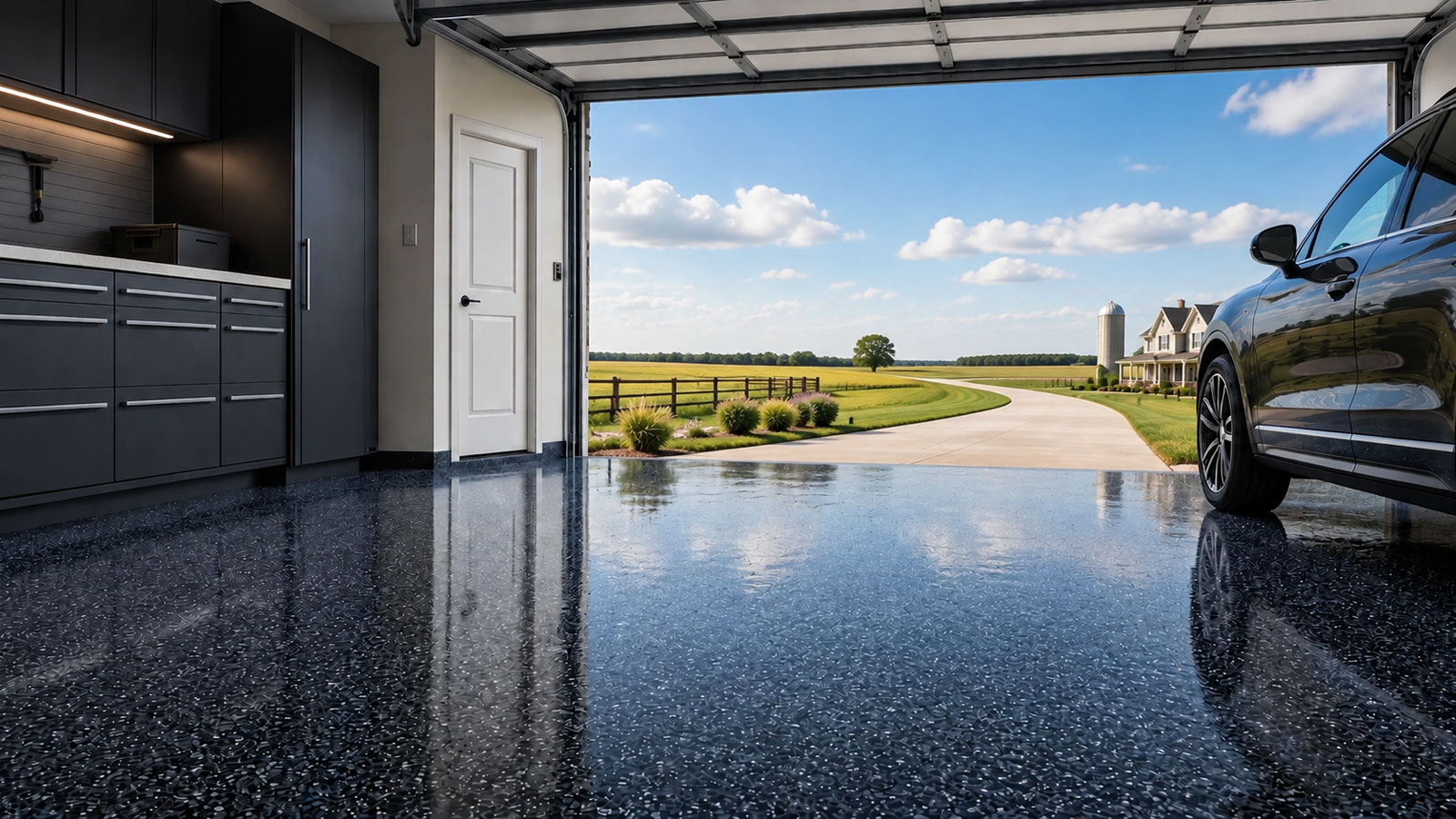
Garage Floor Coating in West Des Moines, IA
Floor Coating Services in West Des Moines, IA
West Des Moines began as Valley Junction, incorporated in 1893 around the railroad. It changed its name in 1938, then expanded dramatically after World War II. Valley Junction garages may also have been altered long after the original house was built, so home age and slab age should be separated. Multiple pours, old coatings and patched utility work can all appear on established properties.
In 1946 the city covered less than two square miles and had about 5,400 residents; during the 1950s it added roughly 15 square miles and doubled in population. Later interstate-era growth pushed development much farther west. The city's growth westward created the opposite condition: younger concrete in larger multi-bay garages, often with builder-applied surface treatments and more complicated layouts. Water history from older flood-prone corridors should likewise be checked at the specific property rather than assumed from citywide history.
That creates a pronounced old-core/new-west garage split. Valley Junction floors may carry decades of paint and repairs, while newer western garages are more likely to raise questions about builder sealers, control joints, and large multi-bay layouts.
Local Market Insight
West Des Moines combines an 1893 Valley Junction core with enormous postwar and interstate-era expansion. Slab age can change sharply from east to west, while flood and creek history adds property-specific drainage questions.
What Affects the Cost of Garage Floor Coating in West Des Moines?
West Des Moines spans older Valley Junction properties and much newer western development. Established floors may need old paint, patches or later additions addressed; young slabs may need sealers and curing products removed. Flood history, driveway runoff, multi-bay geometry, winter residue and edge details can create different labor on otherwise similar-size floors.
Valley Junction slab history
Older east-city properties can contain paint, old patches, previous coatings, or garages added long after the house. Look for repours and old coatings that may not match the original age of the house.
Newer western subdivision concrete
Later development often means younger slabs with curing compounds, sealers, and builder repairs. Younger west-side concrete still needs a verified profile and removal of builder treatments.
Flood and creek drainage
The 1993 flood affected older parts of the city; actual water history should be checked at individual garages. Use actual threshold water and driveway drainage history rather than citywide flood reputation alone.
Control joints and cracks
Modern attached garages often include joints and shrinkage cracks that need evaluation before coating. Cracks and patched areas should be evaluated individually before a continuous finish is installed.
Large garage layouts
Three-car bays, storage extensions, steps, cabinets, and stem walls add labor beyond open floor area. Multi-bay layouts, steps and built-ins can add substantial edge work to newer garages.
Winter use and cure timing
Salt, snowmelt, traction, and the need to return vehicles quickly affect system selection. Choose traction and cure timing around daily household use and winter vehicle return.
Call for a clear, project-specific estimate — or request one online.
Local Garage-Floor Conditions in West Des Moines
In Valley Junction and older east-side areas, inspect for paint, repairs, multiple concrete pours, and old coating edges.
In newer west-side neighborhoods, identify sealers, curing compounds, and construction residue before assuming the slab needs minimal prep.
If the property has flood or creek-drainage history, describe actual threshold water and recurring dampness separately from normal snowmelt.
Valley Junction and modern West Des Moines are different garage markets
The original city grew around the railroad as Valley Junction in the 1890s, while postwar annexation and interstate access created large new residential districts farther west.
An older garage may need coating removal and repairs; a newer garage may need surface treatments mechanically stripped.
The successful system begins with the slab that exists today rather than the age of the city name.
Valley Junction began in 1893 with only about 500 residents, while later postwar and interstate-era expansion pushed West Des Moines far beyond that original railroad core. A floor near the old east side may have decades of paint, remodels, and repours; a newer western garage may instead have a large multi-bay layout, control joints, and builder-applied surface treatments. Those differences affect labor and preparation more directly than the shared city name.
The 1993 flood left a specific local water history
West Des Moines experienced significant flooding in 1993, including damage to the old city offices and other low areas.
That history is relevant when a particular property has recurring water or lies in a known drainage corridor, but it does not diagnose every slab.
A dry garage can focus on normal preparation; active water entry should be corrected before coating.
The flood was significant enough to damage the old municipal offices on 5th Street, after which city operations eventually moved to a newer complex farther west. For a garage owner, that history is useful only when connected to the property: has water ever crossed the threshold, does a low driveway hold runoff, or do slab edges remain damp? A dry garage should not be treated as a flood project simply because West Des Moines has a documented flood history. For West Des Moines homeowners, the practical comparison is between the actual slab history, observed drainage and garage geometry—not simply whether the property is in Valley Junction or newer western development.
Before coating a West Des Moines garage
- Is the property in older Valley Junction/east city or newer western development?
- Is paint, sealer, or old coating present?
- Are cracks, control joints, or repairs visible?
- Has water ever entered the garage?
- Does the driveway slope toward the door?
- How much winter salt reaches the floor?
- Is the garage two-car, three-car, or extended?
West Des Moines Garage Floor Coating FAQs
Are Valley Junction floors too old for coating?
No. Sound older concrete can be a good coating surface when old material, contamination, and repairs are properly addressed. Valley Junction house age does not prove slab age; later garage additions and repours can create multiple concrete conditions in one property.
Are newer west-side slabs automatically coating-ready?
No. Sealers and curing compounds can interfere with adhesion and must be evaluated. Newer west-side concrete still needs sealers, curing products and smooth finishes identified before mechanical preparation is chosen.
Does 1993 flood history mean special coating is always needed?
No. The current slab and property water history should determine the system. The 1993 flood is city history, but the coating scope should change only when the specific property shows water entry or persistent dampness.
Why can larger West Des Moines garages cost more than square footage alone suggests?
Extra bays, steps, stem walls, cabinets, joints, and edge work add labor as well as material. Multi-bay garages often add steps, stem walls, storage edges and joints that increase labor beyond the open square footage.
Why can Valley Junction and newer west-side garages need very different preparation?
An older Valley Junction floor may contain paint, patches and later concrete additions, while a newer western slab may have fewer repairs but still need builder sealers, curing compounds and smooth finishes removed. The preparation should follow the actual slab, not the neighborhood label.
West Des Moines Neighborhoods & Local Context
Phone Quote Line
Speak with a floor coating specialist about your project and get a realistic estimate range.
(515) 346-6077Typical Project Cost
$3,000–$5,500
Typical range for a two-car garage. Final pricing depends on floor size, concrete condition, prep work, coating type, and finish options.
Helpful Guides
Other Service Areas