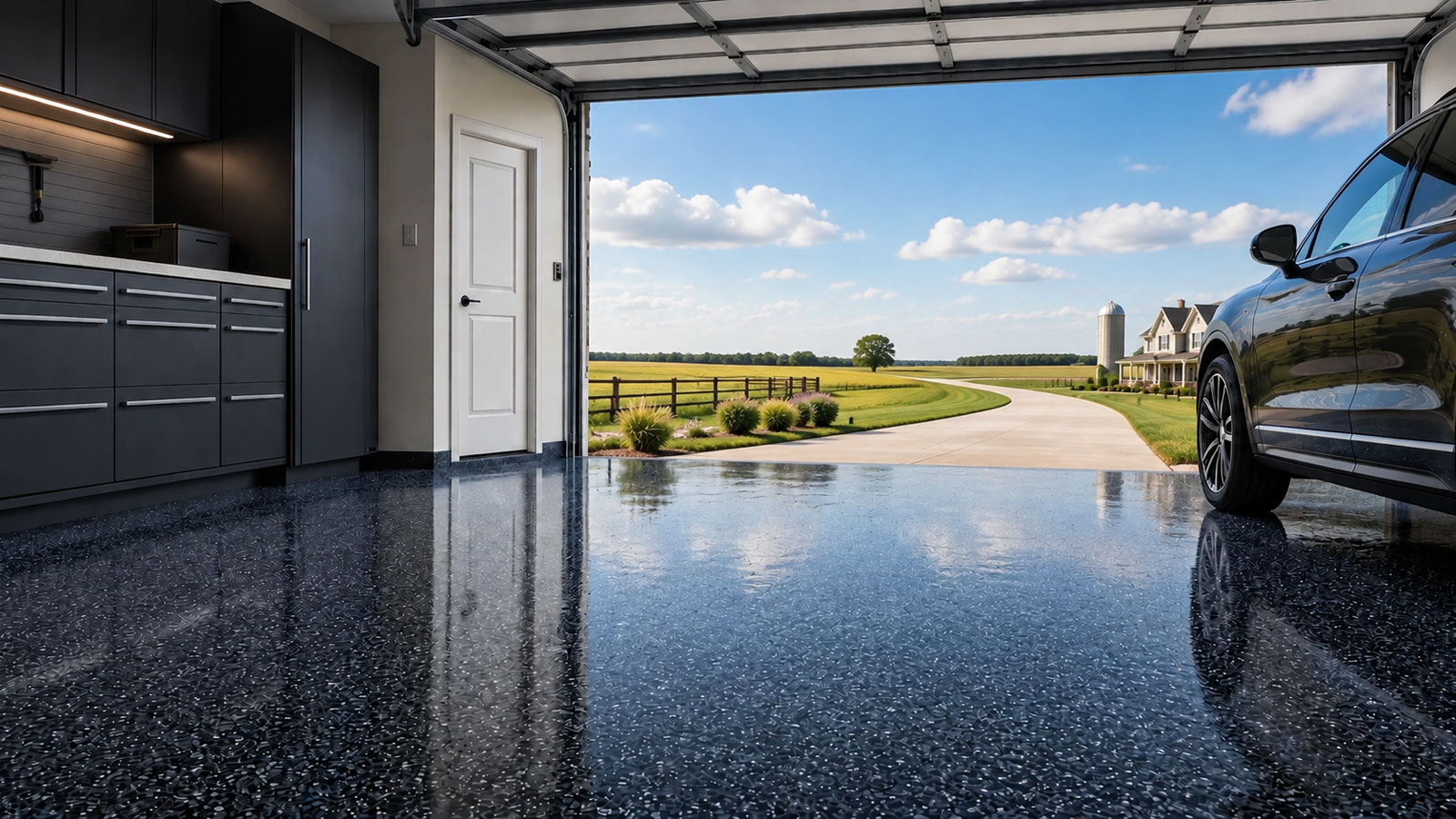
Garage Floor Coating in Grimes, IA
Floor Coating Services in Grimes, IA
Grimes was founded in 1881 and incorporated in 1894, but today's city is dominated by extremely rapid recent growth. Population rose from 8,246 in 2010 to 15,392 in 2020 and about 17,809 by the 2025 special census. That pace of building means many garages are extremely young, yet surface preparation remains critical. Curing compounds, sealers, builder patching, control joints and smooth finishes can all be present before the homeowner ever considers a coating.
Housing growth has been even faster in the most recent period, with the city's housing-unit count increasing by roughly one-third after 2020. That makes young garage concrete a defining local condition. The old-versus-new stormwater split adds a second local distinction. Legacy areas and new subdivisions can move runoff differently, so driveway pitch, low spots and water at the garage threshold should be observed rather than inferred from neighborhood age.
Drainage varies by development era. Older sections rely more on swales and legacy storm lines, while newer neighborhoods use closed storm-sewer systems; downtown has had undersized lines that can pool or back up toward Little Beaver Creek.
Local Market Insight
Grimes combines explosive new-housing growth with a clear old-versus-new stormwater infrastructure split. New-slab preparation and property drainage are especially important local themes.
What Affects the Cost of Garage Floor Coating in Grimes?
Grimes projects often begin with relatively young concrete, but the work still depends on sealers, curing products, builder patches, joints and surface profile. Older areas can add paint or repair history. The city's differing stormwater systems, driveway grading, winter residue and larger garage layouts can further change preparation and finish scope.
Young concrete surface treatments
Many Grimes slabs are relatively new but may have curing compounds, sealers, smooth finishes, or builder residue. Ask how curing compounds, sealers and construction residue will be removed from young concrete.
Builder repairs and control joints
New construction can still contain patched areas, anchor holes, shrinkage cracks, and control joints. Control joints and builder repairs should be assessed rather than hidden under the finish.
Legacy versus newer drainage
Older swales and undersized lines can behave differently from closed storm systems in newer neighborhoods. Check driveway grade and threshold ponding because new and legacy stormwater systems behave differently.
Little Beaver and watershed runoff
Driveway and lot grade should be checked where water ultimately moves toward local creek systems. Older pockets may still have paint or repoured areas requiring separate preparation.
Large family garages
Newer homes often include multiple bays, storage, steps, and primary-entry use. Larger family garages can add bay edges, steps and storage alcoves to the labor.
Winter residue and cure timing
Salt, snowmelt, traction, and how quickly vehicles return affect the system. Finish and cure time should fit daily vehicle use and winter conditions.
Call for a clear, project-specific estimate — or request one online.
Local Garage-Floor Conditions in Grimes
On a newer Grimes floor, identify sealer, curing compound, construction residue, and builder patching before coating.
In older parts of town, check how swales and street drainage behave during major rain, particularly where water moves toward Little Beaver Creek.
At control joints and cracks, ask how the coating system will handle movement rather than simply covering the lines.
Grimes' housing count is growing even faster than its population
Grimes more than doubled in population from 2010 to 2020 and continued growing afterward, while housing units increased roughly one-third in the early 2020s.
That gives the market an unusually large concentration of recent garage slabs.
The most common preparation risk is therefore not age but hidden surface treatments and construction residue.
That housing surge means many Grimes floors have had only a few years of vehicle traffic, but age does not guarantee a simple installation. Young slabs can still contain curing compounds, builder-applied sealers, construction dust, drywall residue, or patched anchor points. In a new-looking garage, the contractor should explain how the surface will be mechanically profiled and how joints or small shrinkage cracks will be treated before decorative layers are applied.
That rapid expansion also makes construction sequence worth asking about. A slab may have been exposed to framing, drywall, painting, and equipment traffic before the homeowner ever parked on it. Overspray, adhesive, rust marks, or patch compounds left from construction can be easy to overlook on a young floor but still need removal. A proper estimate should identify those materials rather than equate “new house” with “minimal prep.”
Older and newer Grimes neighborhoods move stormwater differently
Older areas use more open swales and legacy storm lines, while newer subdivisions generally use closed storm-sewer networks. Downtown has also dealt with undersized lines that can cause pooling and backups.
For a homeowner, the garage-specific check is whether the driveway, curb, or yard drainage sends water toward the slab.
A coating should not be expected to correct a grading or storm-sewer problem.
The drainage contrast also changes what the homeowner should watch during storms. Older areas that rely more on open swales or legacy lines can pond or route water differently from newer closed storm-sewer subdivisions, and downtown has had locations where undersized infrastructure contributed to backups. At the property, curb flow, swales, driveway grade, and apron ponding are the useful clues—not the age of the neighborhood by itself.
Before coating a Grimes garage
- Is the slab recent construction or an older in-town floor?
- Is sealer, curing compound, paint, or coating present?
- Are control joints, cracks, or builder patches visible?
- Does street or lot drainage pool near the garage?
- Does the driveway slope toward the door?
- How much winter salt reaches the floor?
- Is the garage multi-bay or storage-extended?
Grimes Garage Floor Coating FAQs
Are new Grimes slabs ready to coat without much preparation?
No. Young concrete still needs mechanical profiling and any incompatible curing or sealing material removed. New Grimes concrete may look ready while still containing curing compounds, sealers or dense finishes that interfere with adhesion.
Why does neighborhood age matter to drainage?
Older and newer areas can use different stormwater systems, but the actual driveway and threshold remain the key project checks. Older and newer stormwater systems can route runoff differently, so driveway grade and threshold ponding should be checked on site.
Can a control joint be covered?
It depends on the joint and system. The installer should explain how movement will be handled. Control joints are intentional slab features and should be evaluated before deciding whether or how to treat them.
What finish works for a high-use family garage?
Decorative flake with practical traction can balance appearance, dirt-hiding, and cleanability. High-use family garages often benefit from practical traction and easy cleanup more than an overly aggressive texture.
Why does Grimes' rapid housing growth not eliminate preparation concerns?
New construction can still leave curing compounds, sealers, smooth finishes and builder repairs on the slab. Those materials must be identified and mechanically addressed before coating, regardless of how recently the neighborhood was built.
Grimes Neighborhoods & Local Context
Phone Quote Line
Speak with a floor coating specialist about your project and get a realistic estimate range.
(515) 346-6077Typical Project Cost
$3,000–$5,500
Typical range for a two-car garage. Final pricing depends on floor size, concrete condition, prep work, coating type, and finish options.
Helpful Guides
Other Service Areas